
Copper Pipes
Pure Copper for Industrial Applications and Architectural Design
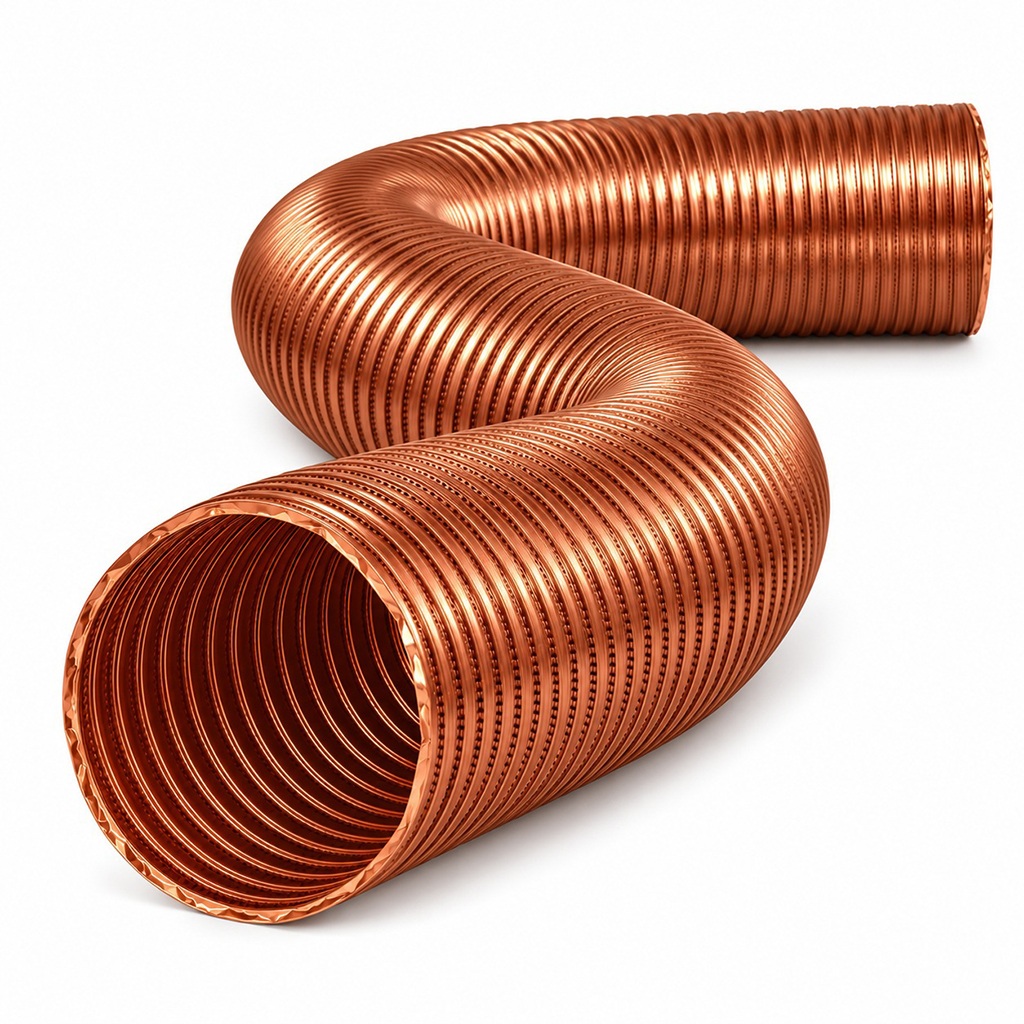
UAS® FUGA semi-flexible copper ducts are manufactured from 100% pure copper strips using a special interlocking seam construction, in diameters ranging from Ø80 to Ø400 mm.
Their high thermal and electrical conductivity, natural antimicrobial surface properties, corrosion resistance and distinctive appearance make them suitable for industrial ventilation, air extraction, specialized mechanical installations and architectural applications.
The semi-flexible construction allows bending, curving and adaptation to different installation configurations.
APPLICATIONS AND TECHNICAL ADVANTAGES
1. Chemical Industry and ATEX Environments
Chemical processing plants, solvent-based paint facilities, ammunition production, flour, starch and carbon processing systems.
Why copper? Its high electrical conductivity allows static charges to dissipate through properly grounded installations. Copper’s relatively low tendency to generate mechanical sparks under certain conditions is an advantage when selecting materials for potentially explosive atmospheres. ATEX applications require appropriate system-level compliance.
2. Metalworking and Heavy Industry
Robotic welding, laser and plasma cutting, foundries, hot-air extraction and industrial gas exhaust systems.
Why copper? With a melting point of approximately 1085°C and thermal conductivity of 385–400 W/mK, copper distributes heat efficiently. Its melting point is significantly higher than that of aluminium. Applications involving hot particles require a construction suitable for the operating conditions.
3. Healthcare, Laboratories and Food Processing
Hospitals, laboratories, biotechnology facilities, food drying and maturation systems.
Why copper? Copper has natural antimicrobial surface properties. Scientific studies have demonstrated reductions of up to 99.9% in certain microorganisms under specific contact conditions. This characteristic contributes to material selection in hygiene-sensitive installations.
4. Marine and Offshore Applications
Commercial vessels, yachts, offshore platforms and ventilation systems in coastal facilities.
Why copper? Copper can develop natural oxide and patina layers that provide surface protection under certain atmospheric conditions. Its corrosion behaviour can offer advantages in marine environments, depending on the application.
5. Architectural Restoration and Interior Design
Historic buildings, museums, hotels, restaurants, wine cellars and exposed mechanical installations.
Why copper? Its natural colour gradually develops brown tones and, under suitable conditions, a greenish patina. The semi-flexible structure allows integration into various architectural designs.
6. Copper Range Hoods and Exhaust Connections
Copper range hoods and suitable exhaust connections in restaurants, hotels and residential kitchens.
Why copper? It provides material and visual consistency with copper range hoods. High thermal conductivity and semi-flexible construction facilitate installation.
7. Shop Windows and Decorative Applications
Showrooms, retail displays, exhibition stands, lighting installations and artistic designs.
Why copper? Its natural metallic appearance, formability and developing patina allow the creation of different decorative configurations.
8. Ventilation and HVAC Systems
Low- and medium-pressure air transfer, local extraction, specialized ventilation and mechanical installations.
Why copper? High thermal conductivity, electrical conductivity and semi-flexible construction provide flexibility for specialized installation requirements.
MATERIAL COMPARISON
Thermal Conductivity
Copper: Very high, 385–400 W/mK
Aluminium: High
Galvanized steel: Moderate
Stainless steel: Low
Electrical Conductivity
Copper: Very high
Aluminium: High
Galvanized steel: Moderate
Stainless steel: Low
Melting Point
Copper: Approximately 1085°C
Aluminium: Approximately 660°C
Galvanized steel: Steel substrate, generally above 1400°C
Stainless steel: Approximately 1375–1530°C
Antimicrobial Surface Properties
Copper: Natural antimicrobial activity
Aluminium: Limited
Galvanized steel: Limited
Stainless steel: Limited
Corrosion and Surface Behaviour
Copper: Natural oxide and patina formation
Aluminium: Protective oxide layer
Galvanized steel: Zinc coating protection
Stainless steel: Passive oxide layer
Main Applications: Industrial extraction, ventilation, air and gas exhaust, specialized mechanical installations, marine applications, architectural decoration and copper range hood connections.
The physical values stated above refer to the copper material. The duct’s operating temperature, pressure resistance and suitability for specific applications depend on its construction and operating conditions.
Manufacturer: Ünveren Hava Sistemleri A.Ş.